From engineering concept to registered design.
Documentation and technical context for Indian Registered Design No. 504827-001, granted by the Patent Office, Government of India under the Designs Act, 2000. An AI-driven, brain-controlled bionic hand integrating adaptive grip pressure regulation and tactile haptic feedback.
In accordance with Indian intellectual property law under the Designs Act, 2000, this entry documents an officially granted and registered design. Design registration protects novel features of shape, configuration, and surface articulation. It is distinct from a utility patent. All technical control systems and experimental algorithms described below represent collaborative research developed at SRMIST.
Registered Design Credential
Authentic Certificate of Registration of Design recorded by The Patent Office, Government of India.
Certificate of Registration of Design
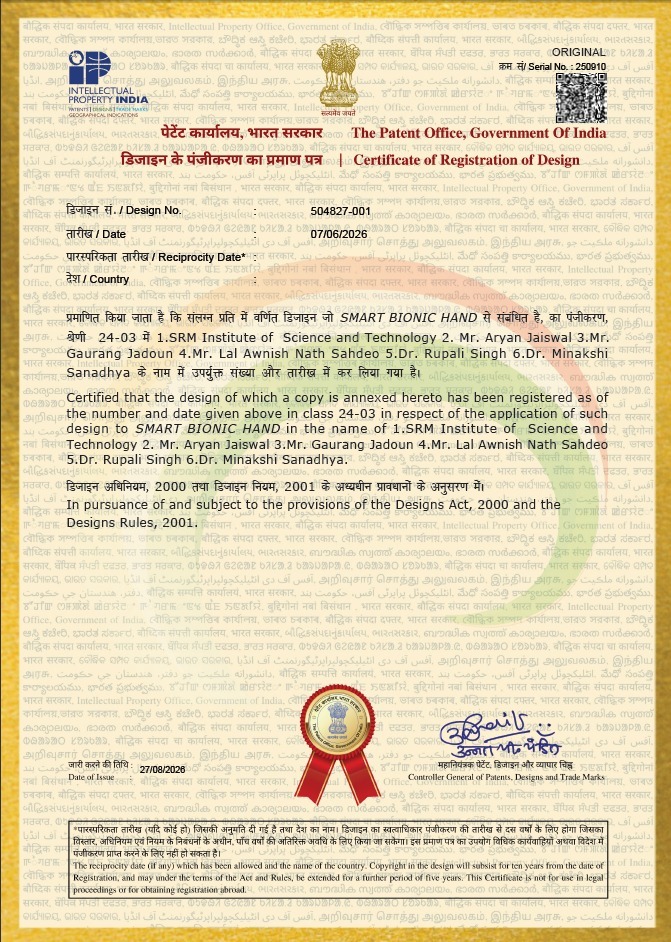
Statutory protection granted under Section 11 of the Designs Act, 2000 for a term of 10 years (extendable to 15 years) from the registration priority date of 07/06/2026.
Interactive Neural Articulator & Force Haptics
Engage with the 5-axis tendon kinematics, adaptive grip presets, and simulated EMG neural wave telemetry.
Adaptive Neural Kinematics & Haptic Telemetry
Simulate 5-axis tendon displacement, dynamic EMG neural impulse patterns, and closed-loop haptic force feedback across distinct functional grip postures.
The Engineering Behind the Design
Overcoming key clinical obstacles in conventional upper-limb prosthetics through adaptive control and sensory feedback.
1. The Clinical Problem: Sensory Deprivation & High Rejection
Commercial myoelectric prosthetics suffer from rejection rates exceeding 40% among transradial amputees. The predominant root cause is the lack of somatosensory feedback: users cannot feel when their terminal device makes physical contact with an object, how hard they are pressing, or when an object is slipping.
Without tactile awareness, users must maintain constant visual fixation on their hand, causing cognitive fatigue and frequent accidental crushing of fragile items.
2. Adaptive Artificial Intelligence Grip Modulation
Rather than executing rigid binary open/close grasps, the proposed system incorporates an embedded closed-loop state machine. Force-sensing resistors (FSRs) at the silicone finger pads sample normal and tangential stress vectors at 200Hz.
When micro-vibrations indicative of surface slip are detected, the embedded controller instantly scales servo torque within 65 milliseconds—well under the 100ms human perception threshold—stabilizing the grasp autonomously.
3. Cutaneous Haptic Actuation
To inform the user without visual dependence, micro-vibrotactile actuators are positioned along the residual limb socket. Frequency and pulse-width modulation (PWM) translate contact onset, sustained pressure, and slip alerts into intuitive tactile sensations against the skin.
4. Honest Status & Verification Scope
Registered Design: Officially granted and recorded by the Patent Office, Government of India (Design No. 504827-001).
Hardware Status: Articulated 5-finger mechanical kinematics and tactile bench prototype validated in laboratory tests.
Clinical Status: Multi-patient human clinical trials and medical-grade EMG electrode arrays are planned future research phases.
Review Full Case Study or Discuss Bionics Collaboration
Explore the detailed technical case study or get in touch for academic inquiries.